For small and medium-sized enterprises (SMEs) in Malaysia and across Southeast Asia, exporting to Europe has long been a pathway to growth. But in 2026, the rules of trade will change—not in tariffs or customs, but in ESG (Environmental, Social, and Governance) compliance.
Europe’s new wave of sustainability regulations will place direct pressure on exporters to demonstrate transparency in carbon emissions, labor standards, and supply chain practices. For SMEs, this is both a challenge and an opportunity.
New ESG Rules in Europe: What’s Coming in 2026
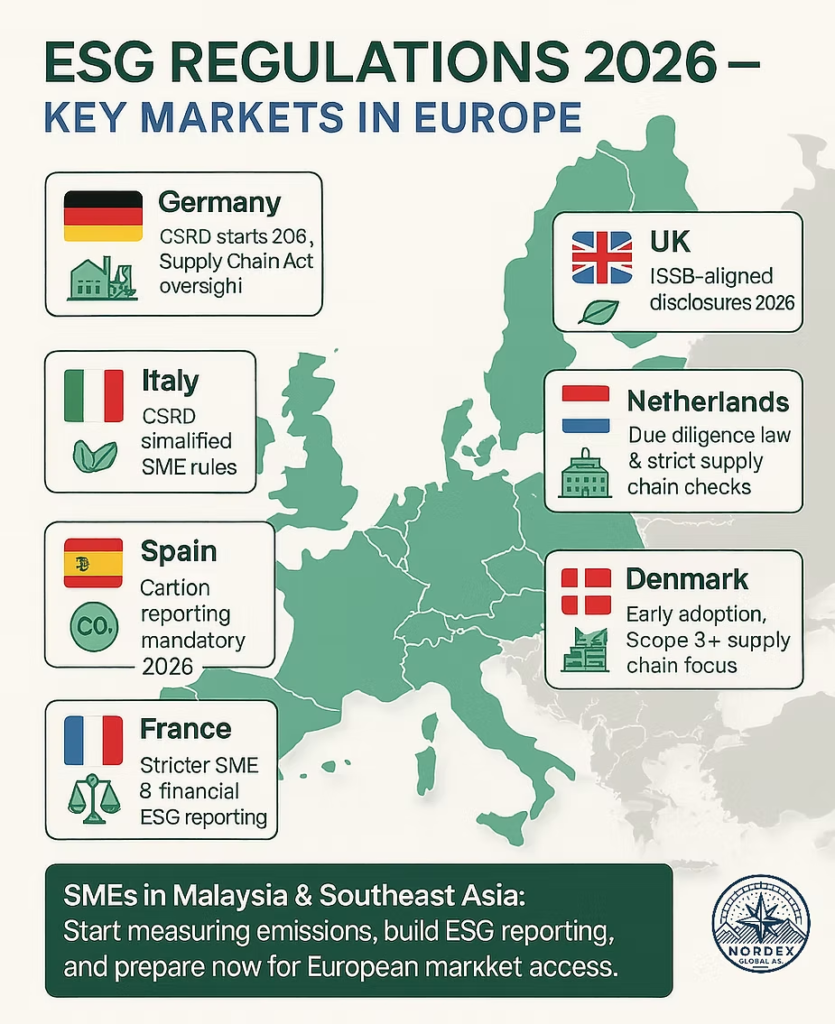
Germany
- The Corporate Sustainability Reporting Directive (CSRD) will require listed SMEs to produce audited ESG reports beginning in 2026, covering climate risks, supply chain impacts, and governance structures.
- Germany’s Supply Chain Act (LkSG)—already binding for large companies—will be evaluated in 2026 and could expand further, forcing stricter oversight of human rights and environmental risks across global suppliers.
United Kingdom
- From 2026, the UK will mandate ISSB-aligned climate disclosures. Even if SMEs aren’t directly subject, UK buyers will cascade these requirements down their supply chains, demanding reliable ESG data from exporters.
Italy
- Italy supports EU sustainability reporting but has argued for simplified standards for SMEs. However, exporters will still be expected to provide baseline ESG disclosures if they want access to Italian clients or EU-linked financing.
Spain
- Royal Decree 214/2025 makes carbon reporting mandatory from 2026, aligning Spain with EU CSRD standards. Exporters to Spain must demonstrate credible emissions tracking and reduction strategies.
Netherlands
- The Netherlands is a strong advocate of the Corporate Sustainability Due Diligence Directive (CSDDD). From 2026 onward, Dutch companies will require suppliers—including Southeast Asian SMEs—to provide evidence of due diligence on labor rights, carbon intensity, and environmental practices.
France
- France has been at the forefront of ESG adoption. From 2026, public SMEs, small financial institutions, and insurers will face tougher ESG reporting rules, creating ripple effects across supply chains.
Denmark
- Denmark is integrating CSRD and due diligence requirements early, setting high expectations for Scope 3 emissions tracking and supply chain transparency. Danish companies are also leaders in renewable energy and green procurement, meaning exporters to Denmark will encounter some of Europe’s strictest ESG expectations.
Why This Matters for Malaysian & Southeast Asian SMEs
- Market Access at Stake: European buyers will favor suppliers who can prove compliance. SMEs that cannot provide ESG data may simply be excluded from tenders or contracts.
- Carbon Costs Rising: With Spain’s carbon reporting, Germany’s supply chain law, and the EU’s Carbon Border Adjustment Mechanism (CBAM), exporters who don’t measure emissions will face both higher costs and barriers at the border.
- Financing & Growth Opportunities: ESG compliance isn’t just about risk—it’s also about opportunity. Many European banks and trade financiers are linking credit terms to ESG performance. SMEs with transparent practices may access cheaper financing and green grants.
- Building Trust & Reputation: In a world where “greenwashing” is under scrutiny, SMEs that can show clear, verifiable ESG reporting will stand out as credible, resilient partners.
What SMEs Should Do Now
✅ Measure Your Emissions – Use Malaysia’s GHG calculator for SMEs to start reporting Scope 1 and 2 emissions. This creates a baseline for compliance.
✅ Adopt Simplified ESG Frameworks – Follow Malaysia’s Simplified ESG Disclosure Guide (SEDG) as a starting point and gradually align with CSRD/ISSB standards.
✅ Talk to Your Buyers – Don’t wait until 2026. Ask European partners what ESG data they need and share your progress transparently.
✅ Monitor Policy Developments – Stay updated on Malaysia’s 2026 carbon tax, EU’s CSDDD, and local sector-specific ESG guidelines.
✅ Invest in Capacity – ESG reporting requires new skills. Train staff, digitize data collection, and build ESG into daily operations rather than treating it as a compliance exercise.
Nordex Global AS Insight
At Nordex Global AS, we view these developments not as barriers, but as gateways to long-term trade resilience. European markets are shifting fast: buyers are no longer looking for the lowest-cost supplier, but for partners who can deliver sustainability, transparency, and trust.
Our work with SMEs shows that even small steps—like starting carbon reporting or setting up a basic ESG framework—open doors to stronger relationships with European clients, preferential supplier status, and access to new financing.
By acting now, Southeast Asian SMEs can transform regulatory challenges into competitive advantages.
Final Word
2026 isn’t far away. The clock is ticking—each month of inaction adds cost and risk. But every step forward today—measuring emissions, improving transparency, training staff—lightens the load tomorrow.
SMEs in Malaysia and across Southeast Asia have the resilience, adaptability, and entrepreneurial spirit to thrive in this new era. Those who prepare early will not just survive the ESG wave—they will lead the future of sustainable trade.